 US | en


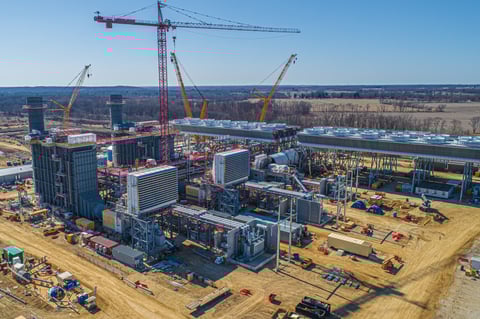
The rapid expansion of data centers is placing new pressure on power infrastructure. From grid constraints to the need for uninterrupted operation, energy reliability has become a defining challenge for facility designers and operators. Liquefied natural gas (LNG) power generation offers a viable solution providing flexibility and a dependable fuel supply.
The Growing Power Demand of Modern Data Centers
AI, cloud computing, and other advanced technologies have driven demand not only for more data centers, but also for significantly greater computing power. High-density racks that house large numbers of servers consume substantial amounts of electricity to maintain continuous operations, placing increasing strain on local utility grids. As a result, power strategy has become a core consideration in modern data center design.
Why Data Centers are Turning to LNG
As a cleaner-burning alternative to diesel, LNG is an ideal solution for data center power generation. The high-energy density and long run-time capability make LNG suitable for prime power, backup power, and peak shaving.
At -260°F (-162°C), the cryogenic liquid reduces the size of natural gas by 600 times, meaning it can be efficiently stored and transported in high volumes without a pipeline. This provides additional flexibility to remote or space-constrained locations.
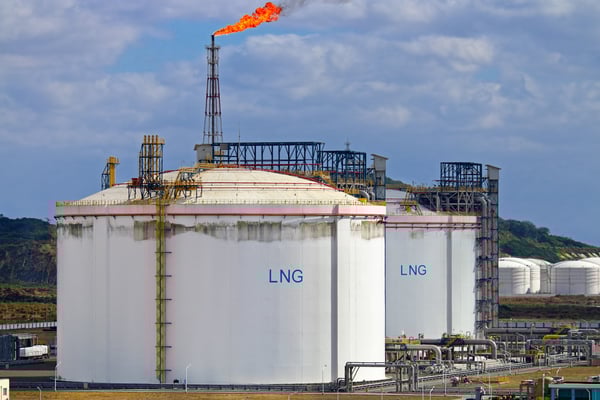 Large LNG tanks at LNG regasification terminal; Photo courtesy of iStock, Sky_Blue
The Infrastructure Behind LNG-Powered Data Centers
LNG-powered data centers rely on a carefully integrated delivery system designed to handle cryogenic temperatures while supporting continuous, reliable power generation. Unlike traditional fuels, LNG must be stored, transferred, and conditioned before it can be used, making infrastructure a critical part of overall system performance.
LNG is delivered to the site and stored in insulated tanks. From there, the fuel is transferred through piping systems to vaporizers, where it is converted from a liquid back into natural gas. The gas is then regulated and delivered to generators or turbines that produce electricity for the data center.
Why LNG Couplings are Crucial in Data Center Power Systems
Cryogenic temperatures introduce thermal stress, material contraction, and safety considerations that standard (non-cryogenic) fuel system components are not designed to withstand. Connection points where hoses, pipes, and equipment interface are particularly critical, because they are often subjected to repeated use during fueling, thermal cycling, and dynamic pressures and flow conditions.
Since data centers require uninterrupted operation, LNG infrastructure must be engineered for reliability and efficiency at every stage.
How Dixon LNG Couplings Support Reliable Data Center Power Generation
Designed specifically for LNG and cryogenic service, Dixon’s LNG couplings are built to maintain connection under extreme conditions to support efficient LNG transfer and reduce risk during critical fueling operations. The couplings are suitable for both permanent and modular power generation setups.
Dixon LNG Products for Data Center Power Generation
LNG Couplings Application
- Transfer of cryogenic LNG products to transport equipment such as cargo tanks, portable tanks, and LNG production facilities
Sizes
- 2” and 3”
Features
- Fixed end design threads on tank truck pipe connection line, manifold, pipe outlet, or pipe connection
- PTFE gasket reduces force needed to make a tight connection
- Connect by hammering the acme threaded nut onto a fixed end
- Female NPT thread hose end attachment
- Snap ring keeps connection nut in place for easier connection
- Hose end lugs intended to be struck with a non-sparking hammer or similar non-sparking device
Materials
- Body: brass
- Seal: PTFE
Specifications
- Compatible with LNG couplings made to CGA guidelines
- Temperature as low as -320°F (-196°C) at standard LNG transfer pressures
- 450 PSI working pressure with 4 to 1 safety factor
Dixon MannTek Cryogenic Dry Disconnects - Hose Unit
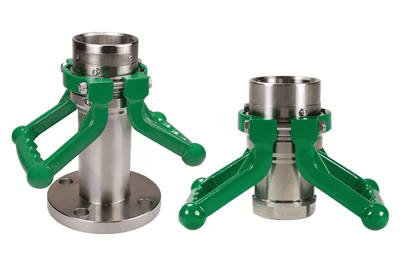 Application
- Container discharge, fuel bunkering, loading/unloading of tank trucks, rail cars, ships, bunkering and tank vessels, and vapor recovery lines. Suitable for cryogenic liquefied gases, such as LNG, nitrogen, oxygen, argon, and ethylene.
Sizes
- 2”, 3”, 4”, 6”, and 8”
Features
- Single action operation uses a straightforward turning motion to connect the couplings and open the flow path
- Safe and reliable: valve cannot be opened until the unit is coupled and it closes automatically when disconnecting, eliminating spills
- Used with a wide range of cryogenic liquefied gases without the risk of cross connection due to human error
Material
- Seals: PTFE
Specifications
- 1” to 4”: 360 PSI maximum
- 6”: 230 PSI maximum
- Temperature rating: -328°F (-200°C) minimum
Cryogenic Industrial Breakaway
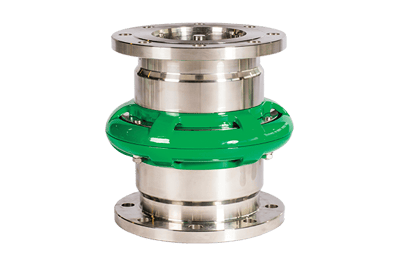 Application
- Container discharge, fuel bunkering, vapor recovery lines, and loading/unloading of tank trucks, rail cars, and ship tankers
Size
- 1”-8”
Features
- Operates independently of shut-off safety system and does not require an external power source
- Lightweight, easy to reset and repair on site with one person
- High flow rate/low pressure drop
- Positive shut-off of both coupling halves results in minimum product loss
- Passive security where a hose or loading arm could be subjected to inadvertent excessive loads
- Can be installed at fixed points or in the middle of hose strings
- Available as industrial or marine types
- No loose components that could be lost after release
Material
- Stainless steel
Specifications
- Connections: female NPT, flanged EN and ANSI, others available on request
- Working pressure: 1” to 4” = 360 PSI, 6” = 230 PSI
- Minimum working temperature: -328°F (-200°C)
Summary
As data centers continue to scale and face rising power demands, LNG power generation is becoming an important part of energy strategies. The success of these systems depends on reliable cryogenic infrastructure. Dixon is committed to supporting LNG applications.
In addition to providing components for data center cooling, Dixon also plays a key role in LNG power generation for data centers, ensuring our partners have the products they need to deliver fuel, maintain uptime, and meet growing demand.
For more information, visit dixonvalve.com or call 877.963.4966.