 US | en


Pressure ratings play a critical role in the safety, performance, and longevity of any hose assembly. Whether used in hydraulic systems, chemical transfer, food processing, or general industrial applications, every hose and fitting is designed to operate within defined pressure limits. Exceeding those limits can lead to leaks, premature wear, equipment damage, or catastrophic failure.
What is a Pressure Rating?
A pressure rating is the maximum internal pressure a component can safely handle under specified conditions. Factors that influence the pressure rating include material, temperature, and chemical compatibility. Pressure ratings are typically provided at ambient temperature (70°F, 21.1°C) unless stated otherwise.
Types of Pressure Ratings
The pounds per square inch (PSI) rating of a hose assembly is important, but the specific type of pressure rating should be identified to clearly indicate the hose assembly's capabilities.
Working Pressure
Sometimes called maximum allowable working pressure (MAWP), working pressure is the maximum continuous pressure the hose assembly can handle safely. This is the number hose assemblies should be designed around.
Burst Pressure
Burst pressure is the pressure at which the hose assembly will fail, typically 3-4x working pressure. This is not a safe operating pressure.
Proof/Test Pressure
Proof/test pressure is the pressure applied during testing to verify the integrity of the hose assembly. This rating is typically higher than working pressure but below burst pressure.
Vacuum Rating
Vacuum rating is the maximum vacuum the hose assembly can withstand without collapsing or leaking. This is important for suction applications.
The Most Important Rule
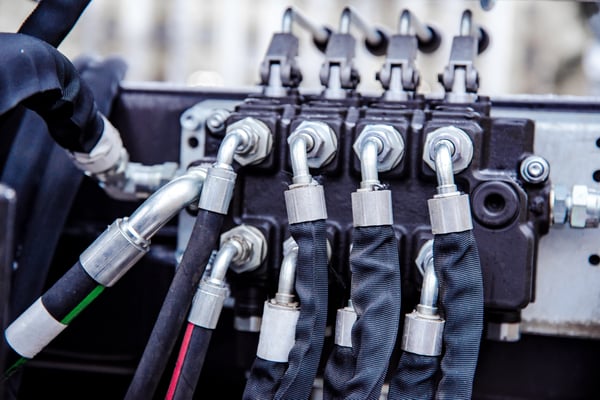
When specifying and creating hose assemblies, always remember the most important rule: the maximum working pressure of a hose assembly is determined by the lowest-rated component in the system.
This means all of the components that make up a hose assembly, including the hose, couplings/fittings, adapters, clamps or crimp sleeves, and gaskets/seals, need to be considered as their individual pressure ratings affect the overall rating.
For example, a 300 PSI hose used with 500 PSI fittings and a 200 PSI adapter has a pressure rating of 200 PSI.
Proper documentation of these ratings, as well as following proper assembly practices, is imperative.
Hose Categories
Hoses are often classified as low pressure, medium pressure, or high pressure, but what does that mean?
Low-Pressure Hose
While classifications vary by product, a low-pressure hose typically has a pressure rating up to 300 PSI. Common applications include air lines, water transfer, and food and beverage transfer.
Medium-Pressure Hose
Depending on the construction, a medium-pressure hose is rated 300-3,000 PSI. A medium pressure hose is often used for chemical transfer, petroleum, and general industrial service.
High-Pressure Hose
A hose with a pressure rating of 3,000 PSI is categorized as a high-pressure hose. Hydraulics, injection systems, and high-pressure cleaning use high-pressure hose.
The Impact of Temperature on Pressure Ratings
Temperature and pressure both play a critical role in hose assembly dynamics. Pressure ratings decrease as temperature increases, a phenomenon known as temperature de-rating. For example, a hose assembly rated at 500 PSI at 70°F (21.1°C) may only be rated for 350 PSI at 200°F (93.3°C).
For assistance with a specific hose assembly, complete the pressure recommendation information form on our website.
Pressure Spikes and Safety Factors
It is important to consider pressure spikes and safety factors when discussing pressure ratings. Some things to consider are pressure surges, water hammer, and hydraulic shock.
Pressure Surges
Pressure surges are sudden, short-duration spikes in pressure that exceed normal operating pressure. Two common causes are water hammer and hydraulic shock.
Water Hammer
Water hammer occurs when the flow of liquid is suddenly stopped or redirected. This is often caused by rapid valve closure, pump shutdown, quick-acting solenoid valves, and dead-heading a pump.
Hydraulic Shock
Hydraulic shock occurs in high-pressure hydraulic systems with rapid directional valve shifts, cylinder bottoming or topping out, and abrupt load changes.
Common Mistakes When Evaluating Pressure Ratings
There is no room for mistakes when it comes to pressure ratings. Some common mistakes that should be avoided to ensure accurate pressure ratings are:
- Ignoring fittings and clamping method
- Confusing burst pressure with working pressure
- Overlooking temperature de-rating
- Not accounting for spikes
- Mixing components without verification
How to Select the Right Hose Assembly
Proper planning prevents poor performance. Dixon recommends using the acronym STAMPED when fabricating and specifying hose assemblies.

Size: What is the inside diameter (I.D.) of the hose? What is the outside diameter (O.D.) of both ends of the hose? What is the overall length of the assembly required?
Temperature: What is the temperature rating of the media (product) flowing through the hose assembly? What is the temperature range of the environment that surrounds the outside of the hose assembly?
Application: How is the hose assembly actually being used? Is it a pressure application? Is it a vacuum (suction) application? Is it a gravity flow application? Are there any special requirements that the hose assembly is expected to perform? Is the hose being used in a horizontal or vertical position? Are there any pulsations or vibrations acting on the hose assembly?
Media: What is the media/material flowing through the hose assembly? Being specific is critical. Check for abrasive materials, chemical compatibility, etc.
Pressure: What is the maximum pressure including surges (or, maximum vacuum) that this hose assembly will be subjected to? Always rate the maximum working pressure of your hose assembly by the lowest rated component in the system.
Ends: What couplings have been requested by the user? Are they the proper fittings for the application and hose selected?
Dixon: Dixon recommends that, based on the hose, fittings and attachment method used, all assemblies be permanently marked with the designed working pressure and intended media. Do not use other manufacturers’ fittings or ferrules with Dixon products due to differences in dimensions and tolerances. We also recommend that all hose assemblies be tested frequently.
Summary
Understanding pressure ratings is essential when selecting and assembling industrial hoses and components. By evaluating the entire hose assembly and considering real-world operating conditions, engineers and maintenance professionals can help prevent failures, extend equipment life, and ensure systems operate safely within their intended limits.
Dixon offers a variety of testing services to ensure products are accurately rated and capable of meeting the demands of a specific application. For more information, visit dixonvalve.com or call 877.963.4966.